Toxic Workplace Environment: When Work Starts Affecting Your Wellbeing
By Manas360 Expert ·
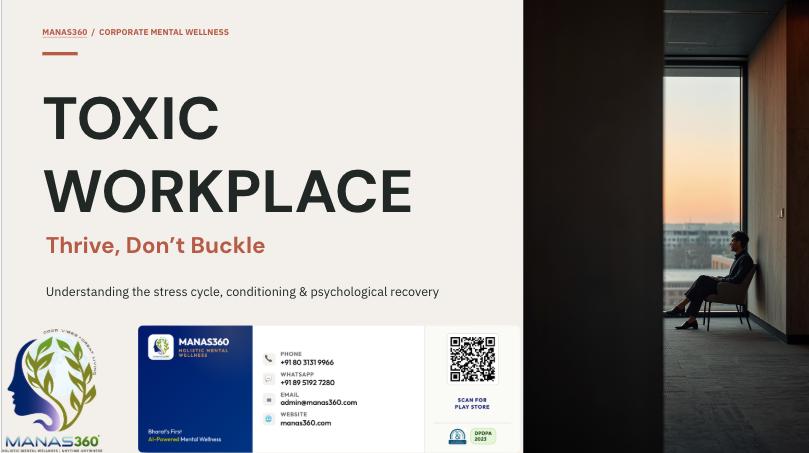
Toxic Workplace Environment: When Work Starts Affecting Your Wellbeing
Work can be stressful. Deadlines, demanding projects, long hours, difficult conversations, and periods of high pressure are all part of professional life. But there is a difference between experiencing workplace stress and working in an environment that is consistently unhealthy.
A toxic workplace environment is one where unhealthy patterns become part of the everyday work culture. It may involve persistent criticism, humiliation, excessive control, unrealistic expectations, poor communication, favouritism, bullying, lack of psychological safety, or a constant sense that employees have to prove their worth.
What makes it particularly difficult is that toxicity does not always appear suddenly. It can develop gradually, until behaviours that once felt unacceptable start feeling like “just how work is.”
What Does a Toxic Workplace Feel Like?
A toxic workplace can leave you feeling that you are always on alert.
You may constantly anticipate your manager’s reaction, worry about making mistakes, check your work repeatedly, or feel anxious before meetings. You may find yourself staying late even when the work could wait because leaving on time creates guilt or fear.
Over time, work can start occupying psychological space even when you are physically away from it.
You finish work, but your mind doesn’t.
You replay conversations.
You think about what you should have said.
You anticipate tomorrow’s problems.
You check messages even when you don’t need to.
You struggle to fully relax.
This is one of the ways chronic workplace stress can begin affecting overall psychological functioning.
The Psychological Symptoms
A prolonged toxic work environment can contribute to symptoms such as anxiety, irritability, emotional exhaustion, reduced concentration, rumination, sleep disturbance and reduced motivation.
You may notice that you are becoming more emotionally reactive than usual. Small things begin to feel overwhelming. You may have difficulty concentrating on tasks that previously felt manageable.
Some people experience hypervigilance—a heightened tendency to monitor their surroundings for potential criticism, conflict, mistakes, or threats.
Others experience emotional detachment. You may stop feeling enthusiastic about work, stop caring about recognition, or simply begin functioning on autopilot.
Neither response necessarily means you are “lazy” or “unmotivated.” They can be signs that your psychological resources have been depleted.
When Your Body Starts Responding Too
Chronic psychological stress is not limited to thoughts and emotions.
Prolonged activation of the stress response can be accompanied by physical symptoms such as muscle tension, headaches, gastrointestinal discomfort, fatigue, changes in sleep, and difficulty relaxing.
You may wake up tired despite sleeping.
You may experience tension in your shoulders or jaw throughout the day.
You may notice your stomach becoming unsettled before an important meeting.
Your body can begin responding to work as though it is something that needs to be constantly prepared for.
This does not mean every physical symptom is caused by workplace stress, and persistent or concerning symptoms should always be medically evaluated. But physical changes can be an important signal that stress is affecting more than just your mood.
Slowly, You Can Start Losing Yourself
Perhaps one of the most overlooked effects of a toxic workplace is how gradually it can change your relationship with yourself.
Initially, you may simply work a little longer.
Then you stop taking proper breaks.
You cancel plans because there is “too much work.”
You stop exercising.
You don’t have the energy to meet friends.
Your hobbies start disappearing.
You become less present with your family.
Eventually, your identity can become increasingly centred around your performance.
How productive am I?
Did I do enough?
Did my manager approve?
Am I falling behind?
Am I good enough?
Work stops being one part of your life and begins becoming the measure through which you evaluate yourself.
This can contribute to a reduced sense of self-efficacy—the feeling that you are capable and effective in your life—and can make your self-worth increasingly dependent on professional performance.
When Survival Becomes the Goal
In a healthy workplace, work can be challenging while still allowing room for recovery, autonomy, relationships and a life outside the organisation.
In a toxic environment, the goal can gradually shift from doing meaningful work to simply getting through the day.
You may begin operating in survival mode:
“Just get through this meeting.”
“Just finish this deadline.”
“Just make it to Friday.”
“Just get through this month.”
And because there is always another deadline, another meeting, or another crisis, recovery keeps getting postponed.
That prolonged cycle can eventually contribute to burnout, which is characterised by emotional exhaustion, increased mental distance or cynicism toward work, and a reduced sense of professional efficacy.
Why People Often Don’t Realise It
Toxic environments can become normalised.
If everyone around you is exhausted, you may assume exhaustion is normal.
If everyone is responding to messages late at night, you may assume availability is expected.
If everyone is afraid of making mistakes, you may assume you simply need to become better at handling pressure.
This is why recognising the environment matters.
Something being common does not automatically make it healthy.
What Should You Pay Attention To?
There is no single symptom that proves a workplace is toxic. Instead, pay attention to patterns and changes in yourself.
Ask yourself:
* Have I become constantly anxious about work?
* Am I unable to mentally disconnect after working hours?
* Has my sleep changed because of work-related thoughts?
* Am I becoming increasingly irritable or emotionally exhausted?
* Have I stopped enjoying things outside work?
* Do I feel that my entire identity revolves around my job?
* Am I constantly afraid of making a mistake?
* Have my relationships or physical wellbeing started suffering because of work?
* Do I feel like I am functioning rather than actually living?
The purpose isn’t to diagnose yourself.
It is to notice when your work environment may be having a sustained impact on your psychological wellbeing.
Your Job Is Important. But It Is Not Your Entire Identity.
A career can provide purpose, financial security, growth and a sense of accomplishment. It is okay to care deeply about your work.
But when professional demands consistently come at the expense of sleep, relationships, physical health, emotional wellbeing and your sense of self, it may be time to pause and reassess.
You don’t have to wait until you completely burn out to acknowledge that something is wrong.
Sometimes the first step is simply recognising:
“This isn’t just a stressful week anymore. This is affecting me.”
And once you can recognise that, you can begin thinking about what support, boundaries, resources or professional help you may need.
Your career can be an important part of your life without becoming the entirety of it.
If you're in distress, you're not alone. Reach out: iCall 9152987821 · Vandrevala Foundation 1860-2662-345 · Tele MANAS 14416.