Why You're So Tired But Can't Sleep: Understanding Sleep Anxiety in the Burned-Out Professional
By Manas360 Expert ·
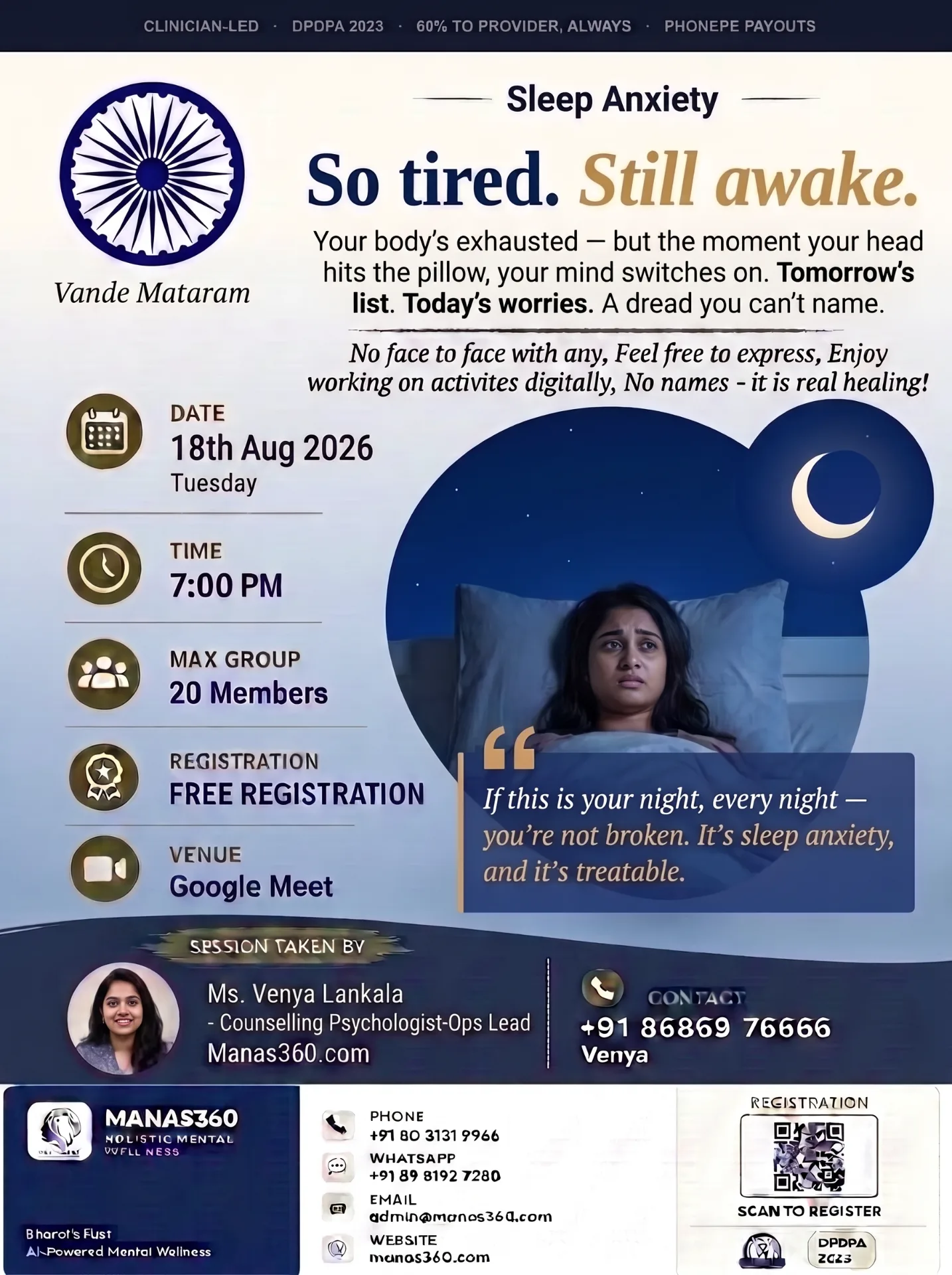
Why You're So Tired But Can't Sleep: Understanding Sleep Anxiety in the Burned-Out Professional
It's past midnight. You've been awake since 6 AM, ran on caffeine and adrenaline through back-to-back meetings, and by evening you could barely keep your eyes open at your desk. So you finally get into bed, exhausted, certain that tonight sleep will come easily.
And then it doesn't.
Your body is heavy with fatigue, but your mind switches on like a light. Tomorrow's deliverables. That email you didn't answer. The thing you said in the 3 o'clock call. A vague, formless dread you can't even name. The harder you try to sleep, the more awake you become — and now a new worry joins the pile: if I don't sleep, tomorrow will be a disaster.
If this is your nightly experience, you are not broken, lazy, or uniquely cursed. You are describing sleep anxiety, and for burned-out working professionals, it has become quietly, painfully common.
What sleep anxiety actually is
Sleep anxiety is the experience of worry, fear, or hyperarousal that interferes with falling or staying asleep. It exists in a frustrating two-way relationship with rest: anxiety makes it harder to sleep, and poor sleep makes anxiety worse the next day. Over time, the two feed each other into a loop that can feel impossible to break.
For many professionals, it takes a particular shape. The bed becomes the first quiet space in a relentless day — and the mind, finally free of external demands, uses that silence to unload everything it has been holding. What looks like "overthinking at night" is often a nervous system that never got the chance to power down during the day.
There's a physiological reason this happens. Chronic stress keeps the body in a state of sympathetic activation — the "fight or flight" mode governed by cortisol and adrenaline. When you are running on stress all day, your body learns to stay switched on. Come bedtime, it doesn't have a reliable way to shift into the "rest and digest" state that sleep requires. You are, in a sense, trying to brake a car whose accelerator is still pressed to the floor.
Why burnout and sleep anxiety travel together
Burnout is more than being tired. It is a state of emotional, physical, and mental exhaustion caused by prolonged stress — and disturbed sleep is one of its most common companions.
The connection runs in both directions. Burnout floods the body with stress hormones that disrupt the natural sleep-wake rhythm. And the resulting poor sleep erodes exactly the resources — focus, emotional regulation, resilience — that you need to cope with the demands driving the burnout in the first place. It is a genuinely vicious cycle, and understanding it as a cycle, rather than a personal failing, is the first step out.
Several patterns are especially common in professionals:
The always-on mind. When work has no clear boundaries — when the laptop comes to bed and the phone buzzes at 11 PM — the brain never receives the signal that the workday is over. It stays in problem-solving mode long after you've stopped working.
Anticipatory anxiety about sleep itself. After enough bad nights, bedtime becomes something you dread. You start watching the clock, calculating how many hours you have left, and that very vigilance makes sleep less likely. The fear of not sleeping becomes the thing that keeps you awake.
Sunday-night dread and performance pressure. For high-achievers, sleep can become one more arena of performance — one more thing to get "right." Paradoxically, treating sleep as a task to be optimised makes it harder, because rest cannot be forced. It can only be allowed.
The cost of chronic sleep anxiety
Left unaddressed, this pattern takes a real toll. Ongoing sleep disruption is associated with impaired concentration and memory, weakened emotional regulation, a lowered immune response, and a higher risk of anxiety and mood difficulties over time.
For working professionals, there is a cruel irony here: the sleep you sacrifice or lose to stress is precisely what you need to perform well and feel like yourself. The all-nighter, the "I'll catch up on the weekend," the reliance on caffeine to paper over the gaps — these are short-term patches that deepen the underlying problem.
Naming this cost is not meant to add to your worry. It is meant to give you permission to take your sleep seriously — not as a luxury or an indulgence, but as a genuine pillar of your health.
Gentle ways to begin loosening the grip
There is no single switch that fixes sleep anxiety, but there are evidence-informed practices that, over time, help the nervous system relearn how to rest. The key word is gently — because forcing rarely works with sleep.
Create a buffer between work and bed. The mind needs a runway to land. A wind-down period — even thirty minutes — of dimmed lights and low-stimulation activity signals to your body that the day is ending. This is not wasted time; it is part of the work of sleeping.
Give your worries somewhere to go before bed. Many people find that writing down tomorrow's tasks and lingering worries earlier in the evening helps get them out of the mind and onto paper. You are telling your brain: these are noted, they are safe, you don't need to hold them all night.
Let go of the clock. Watching the time and calculating lost sleep only feeds anxiety. Turning the clock away removes one of the most reliable triggers of nighttime distress.
Work with your breath. Slow, extended exhales are one of the most direct ways to shift the body out of fight-or-flight. You don't need a perfect technique — simply making your out-breath longer than your in-breath, for a few minutes, begins to tell your nervous system that it is safe to settle.
Protect the boundary between work and rest. This is the hardest and most important one for professionals. If your work has colonised your evenings and your bed, reclaiming even a small boundary — no laptop in the bedroom, a firm end to the workday — can begin to break the always-on cycle.
Be kind to yourself about the bad nights. A poor night's sleep is not a catastrophe, and one bad night rarely ruins the next day the way anxiety insists it will. The gentler you are with yourself about sleep, the less power the fear holds.
When to reach for support
Self-help practices can make a real difference, but sleep anxiety and burnout are not things you have to carry alone, and sometimes they need more than solo effort. If your sleep has been disrupted for weeks, if anxiety is bleeding into your days, or if you simply feel worn down to the point where coping feels out of reach — that is a sign to reach out, not a sign of weakness.
A trained therapist can help you understand what is keeping you awake, address the anxiety and burnout underneath, and build sustainable ways to rest. Approaches like cognitive behavioural therapy for insomnia (CBT-I) and broader work on stress and burnout have strong evidence behind them. Reaching out is not an admission of failure — it is one of the most practical, self-respecting things a person can do.
You are allowed to rest
Somewhere along the way, many of us absorbed the idea that rest must be earned, that being always available is a virtue, that sleep is what you do with whatever time is left over. For the burned-out professional, unlearning this is part of the healing.
You are allowed to rest. Your worth is not measured by how much you can push through on too little sleep. And the nights that feel endless right now can, with support and self-kindness, slowly become something softer.
You don't have to solve it all tonight. You only have to begin.
Struggling with sleep, anxiety, or burnout? You don't have to navigate it alone.
MANAS360 runs small, confidential group therapy sessions for exactly this — professionals learning to quiet the mind and reclaim rest, guided by verified clinical psychologists. It's a space to feel less alone in it, and to build real tools together.
If you're struggling, support is available. In India, you can reach iCall at 9152987821, the Vandrevala Foundation at 1860-2662-345, or MANAS360.com WA +91 89 51 92 72 80. Learn more or find support at manas360.com.
Disclaimer : This article offers general wellbeing information and is not a substitute for professional clinical advice.