Your Gut Is Talking to Your Brain: The Science of How Food and Mood Connect
By Manas360 Expert ·
Your Gut Is Talking to Your Brain: The Science of How Food and Mood Connect
Have you ever called a nervous feeling "butterflies in your stomach"? Or lost your appetite when you were heartbroken, or felt your stomach churn before a big presentation? That everyday language points to something science is now taking seriously: your gut and your brain are in constant conversation.
This connection — the gut-brain axis — has become one of the most fascinating frontiers in wellbeing. It doesn't mean food is a cure for mental health struggles, and it's important to be clear-eyed about that. But it does mean that the relationship between what happens in your digestive system and how you feel in your mind is real, two-way, and worth understanding.
What is the gut-brain axis?
The gut and the brain are linked by a rich communication network — nerves, hormones, and immune signals that carry messages in both directions. The vagus nerve, a long nerve running from the brainstem to the abdomen, acts as a kind of information highway between the two. When scientists talk about the gut as a "second brain," they're referring in part to the enteric nervous system, a vast web of neurons lining your digestive tract that can operate with surprising independence.
Because the traffic flows both ways, the state of your mind can affect your gut — which is why stress can upset your stomach — and, increasingly, researchers are exploring how the state of your gut may influence your mood, stress response, and mental clarity.
The surprising role of gut bacteria
Living inside your digestive system are trillions of microorganisms, collectively called the gut microbiome. Far from being passive passengers, these microbes are metabolically active partners. They help digest food, support your immune system, and — relevant here — participate in producing and regulating some of the very chemical messengers involved in mood.
A striking example: a large share of the body's serotonin, a neurotransmitter closely associated with feelings of wellbeing, is produced in the gut. This doesn't mean gut serotonin works exactly like brain serotonin, or that improving digestion will lift a low mood on its own — the science is more nuanced than the headlines. But it does illustrate how intertwined the two systems are, and why the microbiome has become such an active area of mental-wellbeing research.
What "psychonutrition" actually means
Psychonutrition is the emerging field exploring how nutrition and mental wellbeing interact. It's a genuinely promising area — but it's also one where it's easy to overclaim, so a careful frame matters.
Here's the honest version. There is growing evidence that overall dietary patterns are associated with mental wellbeing, and that supporting gut health may play a supportive role in how we feel. What the science does not support is the idea that any single food, supplement, or eating plan can cure anxiety, depression, or any mental health condition. Nutrition is one thread in a much larger fabric that includes sleep, movement, relationships, stress, genetics, and professional care.
So psychonutrition is best understood not as a treatment, but as one gentle, supportive lever among many — a way of caring for the whole system of body and mind, rather than a fix applied to the mind alone.
An important note of care: this is emphatically not about restriction, "clean eating," rigid rules, or moralising food as good or bad. Those approaches can do real harm. A healthy relationship with food is itself part of mental wellbeing — and any exploration of nutrition and mood should support that relationship, never strain it.
Why stress shows up in your stomach
If you've ever felt your digestion go haywire during a stressful stretch, that's the gut-brain axis in action. When the body is under stress, it shifts into "fight or flight" mode, and digestion — a "rest and digest" function — takes a back seat. Blood flow, gut movement, and even the microbial balance can all be affected.
This is why chronic stress and gut discomfort so often travel together, and why calming the nervous system can sometimes ease digestive symptoms. It's also a reminder that you can't cleanly separate "mental" health from "physical" health. They're one interconnected system, wearing two different names.
Culinary therapy: food as a mindful, joyful practice
One of the most approachable ways to engage the gut-brain connection has nothing to do with rules and everything to do with experience. Culinary therapy uses the act of preparing and sharing food as a mindful, grounding practice.
Think about it: cooking engages all your senses, asks for your full presence, and often connects you to others and to memory. The rhythm of chopping, the warmth of the kitchen, the shared meal at the end — these can be genuinely calming, connecting experiences. Here, food becomes less about nutrition math and more about mindfulness, creativity, and connection. It's a gentle, joyful entry point into caring for both gut and mind at once.
Small, kind ways to care for the gut-brain connection
None of this requires an overhaul or a strict regime. In the spirit of gentleness, a few broad, non-prescriptive ideas:
Tend to your stress, because calming the nervous system supports the gut as much as the mind. Move your body in ways you enjoy, since movement benefits both. Prioritise sleep, which the gut and brain both depend on. Approach eating with curiosity and kindness rather than rules, treating meals as moments of nourishment and, where possible, connection. And notice the mind-body link in your own experience — simply paying attention to how your body and mood talk to each other is a form of self-awareness that supports wellbeing.
These are not medical instructions or a diet plan — they're gentle invitations to treat body and mind as the connected whole they are.
Where this fits in the bigger picture
The gut-brain axis is a genuinely exciting area, and it's empowering to understand that caring for your body is also, in a real sense, caring for your mind. But it's equally important to hold it in proportion. If you're struggling with anxiety, low mood, disordered eating, or persistent digestive distress, food is not a substitute for proper support. These deserve care from qualified professionals — and reaching out for that care is a strength, not a shortcoming.
Understood in that balanced way, the science of the gut-brain connection offers something quietly hopeful: a reminder that wellbeing is whole, that small kindnesses to your body ripple through to your mind, and that caring for yourself can begin in gentle, everyday ways.
Curious to explore this further?
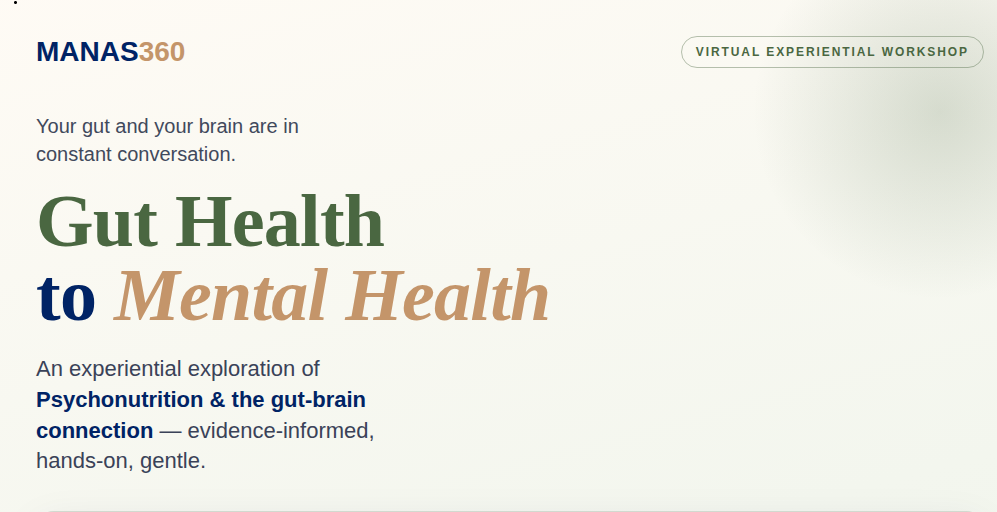
MANAS360 is hosting a virtual experiential workshop on Psychonutrition & the gut-brain connection — evidence-informed, hands-on, and led by qualified facilitators. A space to learn the science and turn it into gentle, practical self-care.
This article offers general wellbeing information and is not a substitute for professional medical, nutritional, or clinical advice. If you're struggling, support is available in India via iCall (9152987821), the Vandrevala Foundation (1860-2662-345). For eating-related distress, the National Alliance for Eating Disorders helpline can help.
Disclaimer - this is intended to create an awareness of Psycho Nutrition connecting Guts and Brain thru' Nutrition Therapy , not a clinical perspective and recommend to connect with a PsychoNutrition Therapist for any disorders.