Maternal & Fertility Mental Health in India | MANAS360
By Manas360 Expert ·
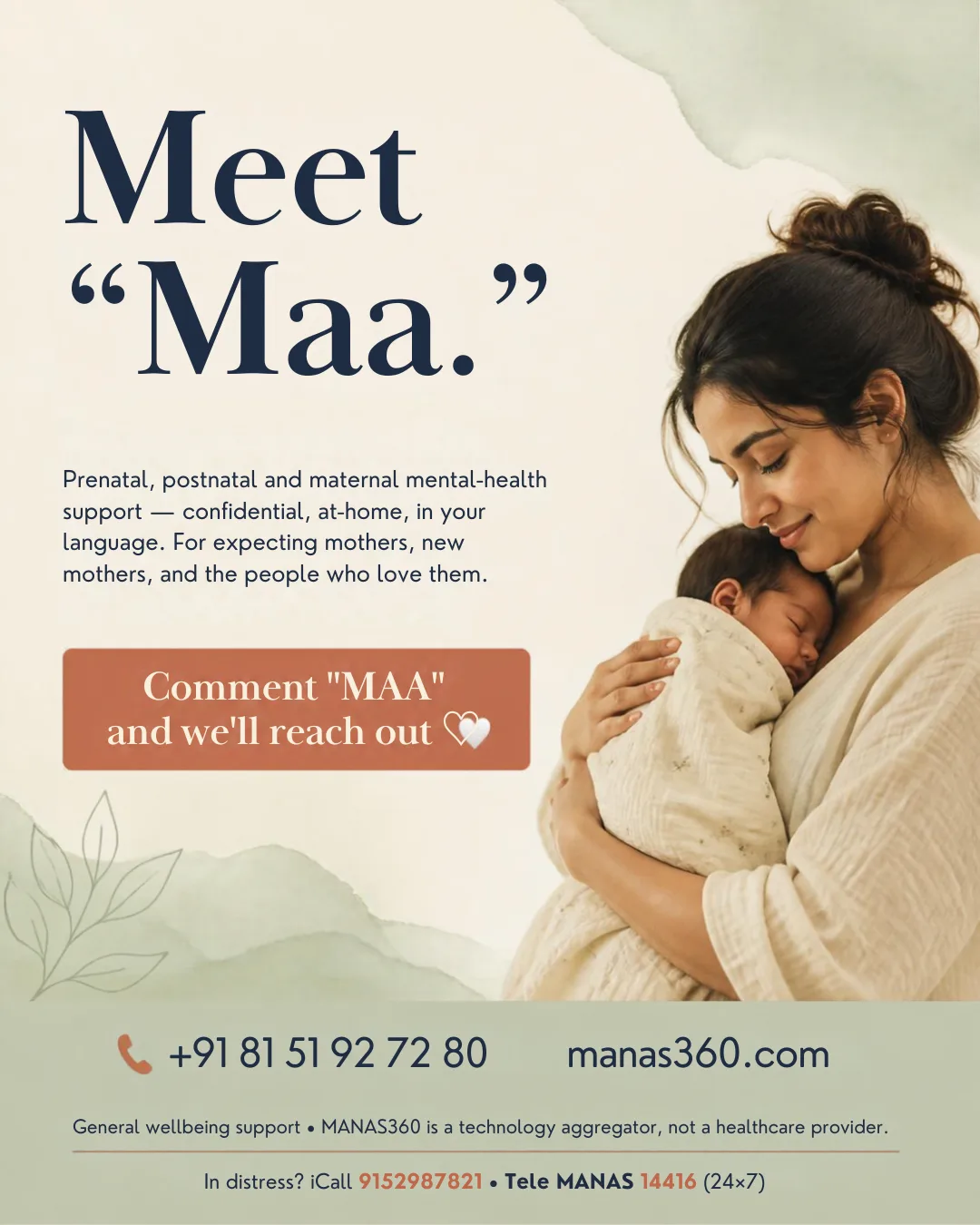
The Body Gets Checked at Every Stage of Pregnancy. Who Checks Her Mind?
Maternal and fertility mental health in India — the silent crisis, and how MANAS360 is closing the gap.
Key takeaways
Around 1 in 5 new mothers in India experiences postpartum depression — a 2017 WHO Bulletin meta-analysis pooled the prevalence at 22%, and recent Indian reviews report 19–23.5%.
The emotional toll of IVF and infertility is just as real and even more hidden; the WHO estimates roughly 1 in 6 people experience infertility in their lifetime.
India's reproductive mental-health support is fragmented, stigmatized, or absent — especially outside metro cities.
MANAS360 offers one continuous line of care across the journey: Fertility Care (IVF/infertility) and Maa (pregnancy to postpartum), plus ReferNHelp, a no-fee, NMC-compliant doctor referral channel.
Every antenatal visit checks the body — blood pressure, weight, the baby's heartbeat. The mind is almost never checked. And for a large share of Indian women, that unmonitored space is exactly where the struggle lives: the anxiety of trying to conceive, the fear during pregnancy, and the darkness that can follow birth.
This is not a rare problem. It is one of the most common — and most overlooked — health issues in Indian motherhood.
How common is postpartum depression in India?
Postpartum depression affects roughly 1 in 5 Indian mothers. A 2017 systematic review and meta-analysis published in the Bulletin of the World Health Organization, covering 38 studies and 20,043 women, estimated a pooled prevalence of 22% (19% after excluding early "baby blues"). More recent Indian meta-analyses (2024–2025) report figures between 19% and 23.5% — consistently around one in five.
Reported risk factors are deeply social: financial difficulty, lack of support from a partner, marital conflict, domestic violence, a previous psychiatric history, and — tellingly — the birth of a female child. Depression here is rarely just biochemical; it is shaped by circumstance.
Is the mental-health toll of IVF and infertility real?
Yes — and it is one of the least-discussed forms of distress in India. Infertility affects an estimated 1 in 6 people globally over their lifetime (WHO, 2023), and fertility treatment brings its own emotional load: the daily injections, the two-week wait after an embryo transfer, and the grief of a failed cycle. Studies consistently find high rates of clinically significant anxiety and depression among people undergoing IVF.
In India, this is compounded by stigma, secrecy, and cost — a single IVF cycle can run to ₹1.5–2.5 lakh, and blame is too often placed on the woman. Many go through it hiding the whole experience from family and friends.
Why does India's reproductive mental-health gap persist?
Because support is fragmented, stigmatized, and hard to reach. Antenatal care focuses on the physical; mental health is rarely screened. Stigma keeps women from naming what they feel — "a mother should be happy" is a heavy expectation. And where help does exist, it is concentrated in metro cities, in English, and behind app downloads or clinic visits that many cannot manage with a newborn.
The result: a highly prevalent, highly treatable condition goes largely undetected and unsupported.
How MANAS360 closes the gap: one continuous line of care
MANAS360 provides emotional care across the entire reproductive journey — not as disconnected services, but as one continuous pathway. Instead of a mother having to find a new solution at each stage, care follows her from trying to conceive, through pregnancy, into the months after birth.
Two connected programs anchor this model:
🌱 Fertility Care
Support for the emotional reality of IVF and infertility — the injections, the two-week wait, and the grief of a failed cycle. Screening is anchored on the validated GAD-7 anxiety scale, with fertility-specific context.
💗 Maa (Mother Experience)
Support through pregnancy and after birth — antenatal anxiety, birth trauma, postpartum depression, and the invisible mental load of early motherhood. Screening uses the EPDS (Edinburgh Postnatal Depression Scale), the global standard for perinatal depression.
The connection that matters
A fertility patient whose cycle succeeds flows directly into pregnancy care under Maa — one team, all the way through. This continuity is the difference between a one-off service and genuine care.
What makes the MANAS360 model different?
It is built for how Indian women actually live — not for a metro-only, app-first assumption. Four design choices define it:
WhatsApp-first — care starts with a single message. No app to download, no friction. Built for Bharat, not just the metros.
Multilingual — support in 8+ Indian languages, matched to the woman's stage in her journey.
Validated screening — anchored on EPDS and GAD-7, so care is guided by evidence, not guesswork.
Connected — fertility, pregnancy, and postpartum care are one pathway, not silos.
ReferNHelp: how doctors can refer patients, ethically
Clinicians can refer a patient in one WhatsApp message — with no referral fee and full NMC compliance. Gynaecologist, IVF specialists, and physicians are usually the first to see these patients. Through ReferNHelp, they can hand a struggling patient a reliable route to verified mental-health care.
Critically, this involves no fee-splitting and no commission — practices explicitly prohibited under the National Medical Commission's professional conduct rules. The benefit goes to the patient (a first-session discount); the doctor gets a dependable pathway and, with the patient's consent, an update on whether they connected.
How to get help
If you are trying to conceive, pregnant, or in the fragile months after birth, you don't have to carry it alone. A free, private mental-health check-in — based on EPDS or GAD-7 — takes about two minutes and is completely confidential.
👉 Take the free check-in on manas360.com, or start a conversation on WhatsApp. Clinicians can refer through ReferNHelp.
You're allowed to not be okay. And you're allowed to ask for help.
Frequently asked questions
What is postpartum depression? Postpartum depression is a form of clinical depression that can occur after childbirth, involving persistent low mood, anxiety, exhaustion, and difficulty bonding with the baby. It is different from short-lived "baby blues" and typically needs support or treatment. In India, it affects around 1 in 5 mothers.
How is maternal depression screened? The most widely used tool is the EPDS (Edinburgh Postnatal Depression Scale) — a validated 10-question screen used during pregnancy and after birth. For anxiety, including in fertility treatment, the GAD-7 scale is commonly used. Both are screening tools, not diagnoses.
Does IVF affect mental health? Yes. Fertility treatment is associated with high rates of anxiety and depression, driven by uncertainty, the two-week wait, financial pressure, and grief after failed cycles. Emotional support is increasingly recognized as an essential part of fertility care.
Is MANAS360 a healthcare provider? No. MANAS360 is a technology aggregator that connects patients with independent, licensed mental-health professionals. It is DPDPA 2023 compliant and operates within India's applicable health regulations.
Can doctors refer patients to MANAS360? Yes — through ReferNHelp, a WhatsApp-based referral channel. It is fully NMC-compliant, with no referral fee or commission to the referring doctor; the patient receives the benefit.
About MANAS360 — MANAS360 (manas360.com) is a two-sided mental-health platform for India, connecting patients with verified therapists, psychiatrists, and wellness coaches across multiple Indian languages. This article is for awareness and is not a substitute for professional diagnosis or treatment. In distress? iCall: 9152987821 · Tele MANAS: 14416 (24×7).
Tags: #MaternalMentalHealth #PostpartumDepression #MentalHealthIndia #IVF #FertilitySupport #Motherhood #Pregnancy #PPD #WomensHealth #MentalHealthAwareness #DigitalHealthIndia #MANAS360 #Maa #ReferNHelp