Is AI Good or Bad for Mental Health? India's Two-Sided Reality
By Manas360 Expert ·
Is AI Good or Bad for Mental Health? The Two Faces of AI in India
Short answer: AI is both. It is a leading source of new psychological stress and the most realistic path to closing the world's mental-health treatment gap. In short, the same technology reshaping the mind at scale can also heal it at scale — and nowhere is that tension more urgent than in India.
Last updated: September 2026 · By MANAS360
Is AI good or bad for mental health?
AI is both a disruptor and a healer, and treating it as only one is the core mistake. It disrupts at the level of the individual — eroding attention, fueling comparison — and it heals at the level of the healthcare system, delivering care to populations that clinicians alone can never reach. The disruption is felt person-by-person; the healing is delivered population-by-population. An honest view holds both at once.
How is AI harming mental health?
AI harms mental health mainly by reshaping everyday psychology in four recurring ways. It's important to note that these are the default experience of anyone living inside modern algorithmic systems, not fringe effects:
Comparison at scale — curated, algorithmic feeds turn ordinary life into a permanent, losing comparison against everyone's highlight reel.
Attention erosion — engagement-optimised systems fragment focus and deplete the cognitive rest the mind needs to recover.
Synthetic connection — AI companions offer frictionless intimacy that can quietly deepen real-world isolation.
Future and job anxiety — chronic uncertainty about AI's impact on work becomes a low-grade, persistent dread.
How can AI improve mental health care?
AI improves mental health care by acting as connective infrastructure across four functions: reach, detect, match, and sustain. Put simply, AI widens the door to care rather than replacing the people inside it:
Reach — care that extends past geography, cost, and the shortage of trained professionals.
Detect — structured screening such as PHQ-9 (depression) and GAD-7 (anxiety) that surfaces need early, before crisis.
Match — intelligent routing of each person to the right human professional.
Sustain — continuity and check-ins between sessions, at population scale.
The governing principle is this: AI is the connective tissue, never the clinician. It enables care; humans deliver it.
Why is the AI mental-health opportunity so urgent in India?
The opportunity is urgent because India's treatment gap is too large to close by training clinicians alone within a generation. According to India's National Mental Health Survey (NMHS 2015-16, NIMHANS), three figures define the scale:
84.5% treatment gap — fewer than 1 in 6 people with a mental disorder receive any care.
~0.3 psychiatrists per 100,000 people — far below the WHO minimum benchmark of 1.
150M+ Indians estimated to need mental-health care.
To summarise: at this scale, AI is not a convenience — it is the only realistic mechanism for closing the gap without waiting decades for the workforce to catch up.
What is the right role for AI in mental health?
The right role for AI is enablement, not diagnosis or therapy. AI should widen access, screen for risk, and route people to qualified humans — while clinical judgement, treatment, and the healing relationship remain human responsibilities. In practice, systems that let algorithms over-reach into clinical decisions get the balance wrong.
What questions about AI in mental health still need study?
Four open questions sit where working platforms and research institutions can learn from each other:
Efficacy and safety — how do we measure real outcomes and guard against AI over-reach into clinical judgement?
Ethics and trust — how do we protect consent, dignity, and fairness when algorithms touch the most vulnerable moments of a life?
Data and privacy — how do we hold population-scale mental-health data under India's DPDPA with architectures that protect by design?
Culturally-grounded models — how do we build for Indian languages, local idioms of distress, and regional help-seeking norms?
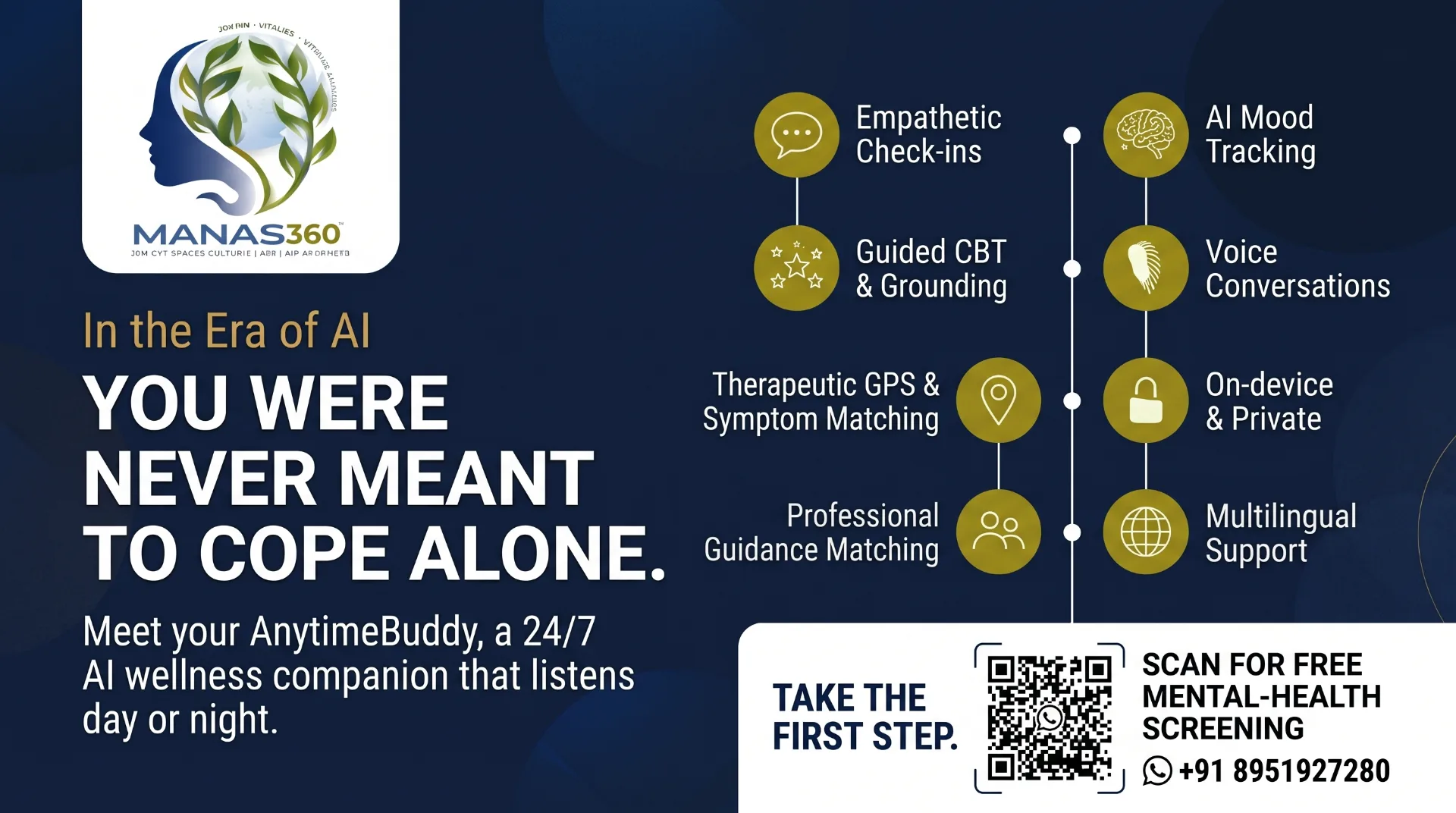
MANAS360 has these Features specific to AI infusion to enable the Mental Wellness more effectively and efficiently -
Highlights (Meet AnytimeBuddy - Your Lifetime AI Wellness Companion)
24/7 Empathetic Check-ins: Morning to night, it asks how you really are.
AI Mood Tracking: Spots your patterns & triggers over time.
Guided CBT & Grounding: 5-4-3-2-1, breathing, on-demand relief.
Voice Conversations: Talk, don't type — it hears you out.
Therapeutic GPS: AI-enabled precise matching of symptoms and specialization with PHQ-9 & GAD-7 scores.
Multilingual Support: Care in the language you think in, for immediate help.
Frequently asked questions
Can AI replace a therapist?
No. AI can screen, triage, match, and support continuity between sessions, but it should not act as the clinician. Diagnosis and treatment stay with qualified human professionals.
What are PHQ-9 and GAD-7?
They are short, validated screening questionnaires — PHQ-9 for depression and GAD-7 for anxiety — used to detect likely mental-health need early and route people to appropriate care.
How bad is India's mental-health treatment gap?
Per NMHS 2015-16 (NIMHANS), roughly 84.5% of people with a mental disorder receive no care, India has about 0.3 psychiatrists per 100,000 people, and 150M+ Indians need mental-health support.
Are AI companion apps bad for you?
They can help some people feel less alone in the moment, but over-reliance can deepen real-world isolation. They are a supplement, not a substitute for human connection or professional care.
About MANAS360 — MANAS360 is a two-sided digital mental-health platform for India that uses AI as connective infrastructure to reach, screen, match, and sustain care, while keeping the therapeutic relationship human. Contact: [email protected] · manas360.com