Gut Health to Mental Health: The Conversation Between Your Gut and Brain
By Manas360 Expert ·
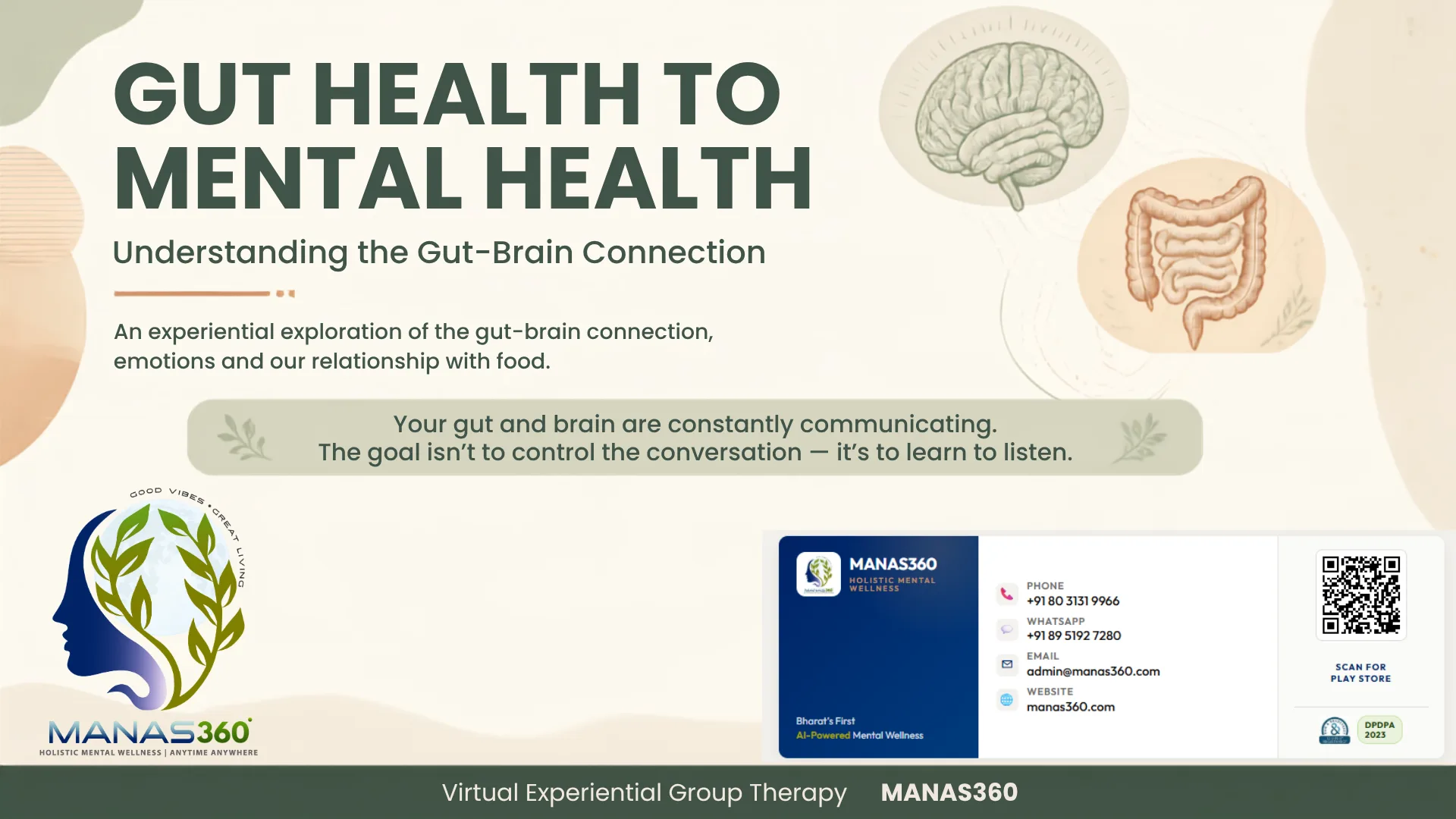
Have you ever had “butterflies” in your stomach before an important event? Lost your appetite after a difficult day? Or reached for comfort food when you’re stressed?
These everyday experiences are small examples of the connection between our gut and our brain.
This relationship is known as the gut–brain axis—a two-way communication network connecting the gastrointestinal system and the brain. It involves the nervous system, hormones, immune pathways and the gut microbiome, the trillions of microorganisms living in our digestive system.
And importantly, the communication goes both ways.
Our emotional state can influence digestion, appetite and gut function, while signals from the gut can also interact with systems involved in mood, stress and behaviour.
It’s More Than Just Digestion
Think about what happens when you’re anxious before an interview.
You might notice your heart racing, your stomach tightening, or your appetite changing.
This happens partly because the nervous system, including the vagus nerve, helps carry signals between the brain and digestive system.
Stress can also influence hormonal and immune processes, while the microbiome interacts with our body through various biological pathways.
But this doesn’t mean that “fixing your gut” will automatically fix your mental health.
The science is much more complex than that.
Instead, the gut–brain connection reminds us that mental and physical wellbeing are deeply interconnected.
When Emotions Influence Eating
Our relationship with food is psychological as well as biological.
Food can mean comfort, celebration, connection, culture and even memories.
Over time, we can also develop learned associations.
For example:
Stress → Comfort food → Temporary relief
When this happens repeatedly, the brain may begin associating stress with that particular behaviour.
This is where conditioning can play a role.
The goal isn’t to label emotional eating as “bad” or to remove food as a source of comfort.
The goal is to create more choices.
Instead of:
Trigger → Automatic response
we can practise:
Trigger → Pause → Notice → Choose
Creating the Pause
When you notice yourself reaching for food automatically, try asking:
What am I feeling?
What is happening in my body?
Am I physically hungry, emotionally overwhelmed, or both?
What would support me right now?
Sometimes the answer will be food—and that’s completely okay.
Other times, you may need rest, connection, movement, a break, or simply some space to process your emotions.
The point isn’t to control the response.
It’s to become aware enough to have a choice.
A More Mindful Relationship With Food
Mindful eating is another way to bring awareness into the experience.
Instead of rushing through a meal while scrolling or working, occasionally slow down and notice:
How does it look?
What does it smell like?
What is the texture?
How does it taste?
What sensations do I notice in my body?
This isn’t about eating perfectly or following another set of food rules.
It’s simply about being present.
And that same principle can extend beyond eating:
Notice your body.
Notice your emotions.
Notice your patterns.
Respond with curiosity rather than judgment.
The Bigger Picture
The gut–brain connection isn’t a magic solution to mental health.
It’s one piece of a much larger picture that includes sleep, movement, relationships, stress management, nutrition and appropriate psychological or medical care.
Perhaps the most useful question isn’t:
“What food will fix me?”
It’s:
“What is my body trying to tell me?”
Because sometimes supporting our mental wellbeing begins not with controlling our body, but with learning to listen to it.
Your gut and your brain are constantly communicating.
The goal isn’t to control the conversation.
It’s to become better at listening.
If stress, emotional eating, body image, digestive concerns, or your relationship with food are affecting your wellbeing, consider reaching out to an appropriate mental-health or healthcare professional.
At MANAS360, we believe mental wellbeing is holistic—and that understanding yourself is an important part of caring for yourself.
Tags: Gut health, mental health, psychonutrition