Is It You, or Is It Perimenopause? Mood, Sleep and Anxiety After 40
By Manas360 Expert ·
Is It You, or Is It Perimenopause? Mood, Sleep and Anxiety After 40
By the MANAS360 team · 8-minute read
You walk into a room and forget why. You snap at your teenager over nothing, then feel terrible about it. It’s 3 a.m. and you’re awake again, mind racing.
Family says it’s stress. Friends say “adjust kar lo.” But if you’re in your 40s and these changes arrived together, there may be another explanation: perimenopause.
What is perimenopause?
Perimenopause is the transition before menopause, when hormone levels swing and periods become irregular. It can last 4–10 years. Menopause itself is one day: 12 months after your last period. Everything before that is perimenopause.
Most women expect hot flushes. Few expect what often comes first: changes in the mind.
Can perimenopause cause mood swings and anxiety?
Yes, perimenopause can cause mood swings, irritability, anxiety and low mood, often before hot flushes begin. Oestrogen affects serotonin, the brain chemical linked to mood, and it also shapes sleep. When oestrogen rises and falls unpredictably, mood can follow.
Women who have had strong PMS, PMDD or low mood after childbirth are often more sensitive to these hormonal shifts.
Common mind and mood changes include:
Irritability and a short temper
Anxiety, tension or feeling on edge
Low mood or losing interest in things
Brain fog: forgetting words, names, why you walked in
Broken sleep and early waking
Lower confidence and self-esteem
What are the first signs of perimenopause?
A change in cycle length of 7 days or more is a common first sign that perimenopause has started. Doctors use a staging system called STRAW+10: cycles that vary by a week or more mark early perimenopause, and gaps of 60 days or more mark late perimenopause.
Other early signs include night sweats, hot flushes, heavier or lighter periods, and sleep that no longer feels restful.
Is it perimenopause or depression?
Perimenopausal low mood often comes with brain fog, broken sleep and irritability, which standard depression checks can miss. That’s why researchers at Monash University created the Meno-D, a 12-item scale built for depression during the menopause transition.
The simplest clue is timing. Ask yourself:
Did the mood change begin around when my periods started changing?
Does it come with night sweats, hot flushes or broken sleep?
Is it worse than how I felt before my 40s?
If you answer yes to these, perimenopause is likely part of the picture. It may not be the whole picture. Thyroid problems, anaemia and some medicines cause similar symptoms, so a doctor should check these too.
What is the Meno-D?
The Meno-D is the first validated rating scale built specifically for depression during the menopause transition. It was developed in 2018 by Professor Jayashri Kulkarni and her team at Monash University’s HER Centre Australia.
It has 12 questions. Each one asks how much a symptom has changed over the last 2 weeks, compared with how you were before perimenopause, scored 0–4. The total runs from 0 to 48.
The 12 questions fall into five areas:
Area What it looks at
Self Energy, self-esteem, anxiety, wanting to withdraw, feeling others are against you
Sleep Sleep quality and irritability
Cognitive Memory and concentration
Somatic Body aches and unexplained weight change
Sexual Changes in interest in intimacy
Why the Meno-D matters for women in India
Using the Meno-D helps Indian women and their clinicians in five ways:
It catches what general depression checks miss. Irritability, wanting to be alone, suspiciousness and weight change are core Meno-D items. Women often describe them as “gussa” or “kisi se baat karne ka mann nahi” rather than as sadness.
It compares you with yourself. Every question asks about change from your pre-menopausal self, which answers the “everyone is stressed” dismissal.
It links body and mind. Aches, weight and sleep sit next to mood, which fits how many Indian women first describe distress: through the body.
It gives a treatment map. A therapist can see which area is driving the score, such as sleep or cognition, and start there.
It is short. About 2 minutes, self-reported, easy on a phone.
What goes wrong when it isn’t used?
Without a menopause-specific check What happens
Mood is read as general depression The hormonal link is missed and no gynaecologist is involved
Symptoms are called “stress” or “age” The woman is told to adjust and gets no care
Aches and fatigue go only to a physician Tests come back normal and the mood problem is never treated
Irritability and suspiciousness are seen as personality or family conflict Relationships suffer and the woman blames herself
Changes in intimacy are never asked about Couple strain goes unspoken
No baseline is recorded Nobody can tell whether treatment is working
Its limits in the Indian context
The Meno-D is a strong starting point, not a finished tool for India:
It was validated with 82 women in Australia. It has not yet been validated in Indian women.
The official version is in English. Hindi, Kannada and other versions need careful translation and testing.
Questions on intimacy and on feeling others are against you may be under-reported because of stigma.
It has no question on suicidal thoughts, so it must be paired with a safety question. The Perimenopause Mind Check pairs it with PHQ-9 item 9.
It is copyrighted (© Kulkarni 2018), and commercial use needs permission from the developers.
Why does life feel heavier at 40+?
The transition rarely arrives at a quiet time. Many women in their 40s are caring for ageing parents and teenage children while managing a career or a home, often both. Hormonal change on top of this load is why many women say they “don’t feel like themselves.”
In India, these changes are rarely named. Women are expected to keep going. Naming what’s happening is the first step to feeling better.
Does therapy help with perimenopause mood symptoms?
Cognitive behavioural therapy (CBT) helps with low mood, anxiety, sleep and hot-flush distress during the menopause transition. The UK’s NICE guideline on menopause lists CBT as an option for these symptoms, alongside or instead of hormone treatment.
CBT teaches practical skills: calming the body during a hot flush, breaking the cycle of worry at night, and changing the thoughts that drive low mood. Most programmes run 6–8 sessions.
Therapy works best alongside a gynaecologist, who can confirm your stage and discuss hormonal and non-hormonal options.
Take the free Perimenopause Mind Check
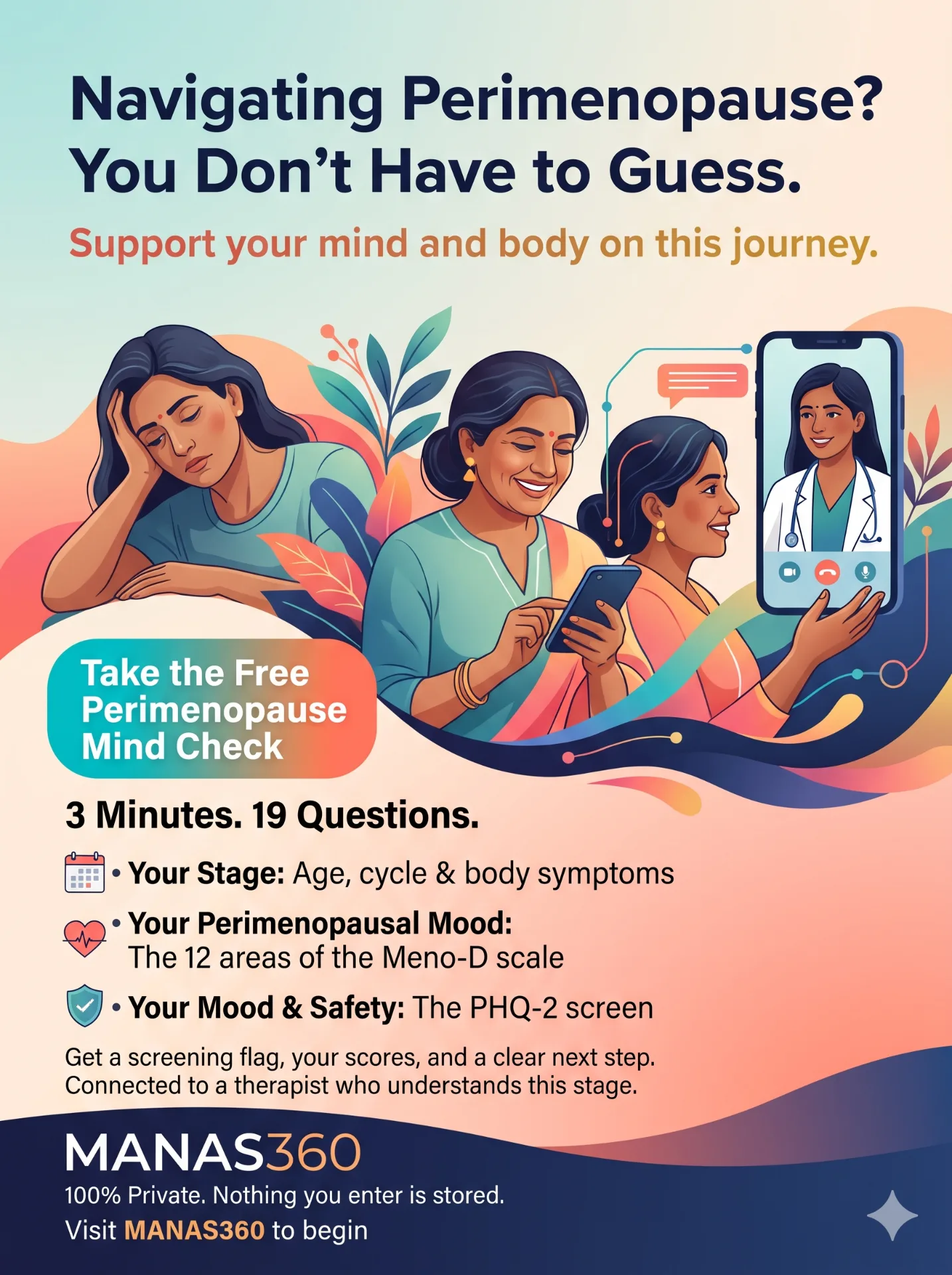
You don’t have to guess. MANAS360’s free Perimenopause Mind Check takes 3 minutes and 19 questions. It looks at three things together:
Your stage: short questions on your age, cycle and body symptoms
Your perimenopausal mood: the 12 areas of the Meno-D scale
Your mood and safety: the PHQ-2 screen and one safety question
You get a screening flag (likely related, possibly related, or other factors more likely), your scores, and a clear next step. If you need support, it connects you to a therapist who understands this stage. Nothing you enter is stored.
Take the free Perimenopause Mind Check →
Know a woman who needs this? Your mother, your sister, your colleague. Send it to her.
This article is for information only and is not medical advice. The Perimenopause Mind Check is a screening tool, not a diagnosis. MANAS360 is a technology platform connecting you with independent licensed mental health professionals — not a healthcare provider.
Need to talk to someone now? Tele MANAS 14416 · iCall 9152987821 · Vandrevala Foundation 1860-2662-345 · Emergency 112
FAQ
Place these at the end of the published post. They match the FAQ schema above word for word.
Can perimenopause cause mood swings and anxiety? Yes. Swinging oestrogen levels affect serotonin and sleep, so irritability, anxiety and low mood are common in perimenopause, often before hot flushes begin.
At what age does perimenopause start? Usually in the 40s, and it can begin 4–10 years before the last period.
How do I know if my mood change is perimenopause or depression? Look at timing. If mood changes began around when your cycle changed, and come with night sweats or broken sleep, perimenopause is likely involved. A screening check and a clinician can confirm.
Is there a free perimenopause test online? MANAS360’s Perimenopause Mind Check is free, takes 3 minutes and stores nothing. It is a screening tool, not a diagnosis.
Does therapy help with menopause mood symptoms? Yes. CBT helps with low mood, anxiety, sleep problems and hot-flush distress during the menopause transition.
What is the Meno-D scale? The Meno-D is a 12-item rating scale for depression during the menopause transition, developed by Professor Jayashri Kulkarni at Monash University in 2018. It covers self, sleep, cognitive, somatic and sexual changes, scored 0–48.
Sources
NICE: updated guideline recommends more treatment choices for menopause symptoms, on CBT for hot flushes, sleep and depressive symptoms (guideline NG23)
NovoPsych: Meno-D overview, for the five subscales and item-level flagging
The STRAW+10 cycle thresholds and the 4–10 year span are standard clinical knowledge. Ask your CAB to add a citation before publishing.
Tags: #AyushForMentalHealth #Navratri2026 #mentalhealthindia #mindfulness #mentalhealth #therapyiscool #Perimenopause #MenopauseIndia #MoodSwingsYaHormones #WomenAt40 #MidlifeMind