Mindfulness for Couples: 3 Simple Daily Steps in India
By Manas360 Admin ·
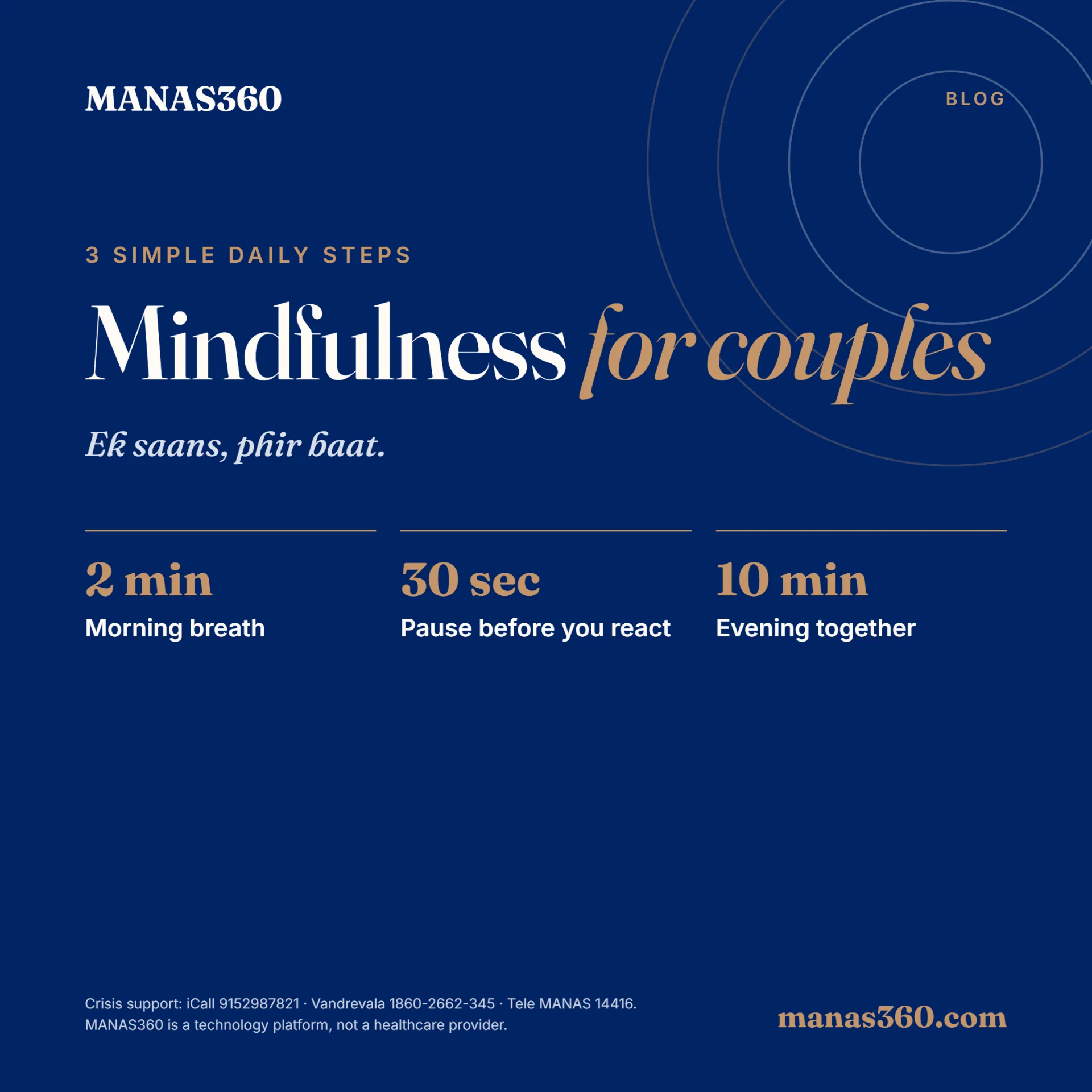
Mindfulness for Couples: 3 Simple Daily Steps
Nov 15, 2026 · @Mahan
Small, daily practices to protect your relationship from everyday stress — in a metro flat, a joint family home or a small-town house.
Why mindfulness, and why now
For most Indian couples, stress doesn't arrive as one big crisis. It builds quietly: a two-hour commute, a manager who messages at 10 pm, EMIs, a child's exams, a parent's health, and a home where there is rarely a quiet corner to yourselves. By the end of the day, there is little patience left — and it often runs out on the person closest to you: your partner.
Many of us also grew up with an unspoken rule: adjust karo, don't talk about feelings, keep the peace in front of the family. So tension doesn't get expressed. It gets stored — and then it leaks out as taunts, silence or sudden fights over small things.
Mindfulness is a simple way to catch that tension early. It means paying attention to the present moment, on purpose, without judging it. It is not about emptying your mind or meditating for an hour. For busy couples, it works best in small, repeatable doses woven into the day.
In couples therapy, approaches like Emotionally Focused Therapy (EFT) help partners spot the negative cycle they fall into when they feel disconnected. Mindfulness is the everyday practice that makes that possible: you cannot step out of a cycle you don't notice you're in.
Here are three simple steps: one for the morning, one for the moment of tension, and one for the evening.
Step 1: The morning arrival (2 minutes, alone)
Before you open WhatsApp, office mail or the family group, give yourself two minutes to "arrive" in your day.
How to do it:
Sit or stand still. Feet on the floor, hands resting. A balcony, the terrace or even the bathroom works if the house is busy.
Breathe slowly. Breathe in for a count of four, out for a count of six. Longer out-breaths help calm the body's stress response.
Check in with one question: "What am I feeling right now?" Name it in one or two words: tired, anxious, irritated, hopeful.
Set one intention. For example: "Today I'll notice when I'm stressed before it spills onto my partner."
Why it helps: Naming an emotion, even silently, helps lower its intensity. You start the day knowing your own weather, instead of discovering it in the middle of an argument.
If you prefer traditional practices, replace the count breathing with a few rounds of gentle Anulom Vilom (alternate-nostril breathing) or Bhramari (humming bee breath). Both are simple, calming and already familiar in many Indian homes.
Step 2: The pause before you react (30 seconds, in the moment)
This is the step that protects your relationship. Most fights between tired partners happen in the half-second between feeling triggered and saying something sharp — often in front of children or family, which makes the hurt bigger.
When you notice a flash of irritation, hurt or defensiveness, use the S.T.O.P. pause:
S — Stop. Don't speak yet.
T — Take a breath. One slow breath, in and out.
O — Observe. What is happening in your body? Tight jaw, racing heart, heat in your chest? What is the softer feeling underneath: hurt, fear, feeling unsupported or unseen?
P — Proceed. Respond from that softer feeling instead of the sharp one.
An example:
Without the pause: "You never take my side in front of your mother."
With the pause: "I felt alone in that conversation today. It would mean a lot if we could talk about it together, just the two of us."
The sharp reaction is usually a secondary emotion; the softer feeling is the primary one. Mindfulness gives you just enough space to reach it. If your heart is pounding and you can't think clearly, take a short, agreed break — a walk, a glass of water — and come back to it, rather than pushing on.
Step 3: The evening connection ritual (10 minutes, together)
The first two steps are for you. This one is for the two of you — and in a busy Indian household, it may be the only private time you get.
Pick a regular time: after dinner, on an evening walk, on the terrace, over chai once the kids are asleep. Phones away, TV off.
How to do it:
Arrive together (1 minute). Sit side by side and take three slow breaths together. It signals: we're switching from duties to us.
Share one high and one low (5 minutes). Each partner takes a turn. The listener's only job is to listen fully: no fixing, no advice, no defending. Just reflect back: "That sounds really tiring." or "I'm glad that went well."
One appreciation (2 minutes). Name one specific thing your partner did today that you valued. "Thank you for handling the school call so I could finish my meeting."
One closeness question (2 minutes). Ask: "Is there anything you need from me tomorrow to feel supported?"
Why it helps: This ritual builds the three things EFT says make a bond feel secure: being accessible, responsive and engaged. Done daily, it creates a steady rhythm of connection that stress can't easily break.
Making it stick
Start smaller than you think. One step done daily beats three steps done once.
Attach it to something you already do. Morning breathing after your first glass of water; the evening ritual after dinner or the night walk.
Protect your 10 minutes. In a joint family, it's okay to say, "We're going for a short walk." Private time is not selfish; it keeps the whole home calmer.
Don't police each other. Mindfulness is a gift to yourself and your relationship, not a rule to enforce on your partner.
Be patient with bad days. Some days the pause won't happen and you'll snap. Noticing it afterwards, and saying sorry, is mindfulness too.
When daily practice isn't enough
Mindfulness is a powerful everyday tool, but it is not a replacement for professional support. If you keep getting stuck in the same painful fights, if trust has been broken, or if one of you is struggling with persistent low mood, anxiety or sleep problems, a trained therapist can help you go deeper. Seeking help is a sign of strength, not weakness — and it can be private, online and in your own language.
Feeling the strain at home? MANAS360 connects you with verified therapists trained in mindfulness-based approaches, EFT and the Gottman Method — online, confidential, in your language, from ₹299 a session. Book at manas360.com.
This article is for general education and is not a substitute for professional care. MANAS360 is a technology platform connecting you with independent licensed mental health professionals — not a healthcare provider. Crisis support: iCall 9152987821 · Vandrevala Foundation 1860-2662-345 · Tele MANAS 14416.
Tags: #AyushForMentalHealth #Navratri2026 #mentalhealthindia #mindfulness #mentalhealth #therapyiscool, #MindfulnessForCouples #DailyMindfulness #MindfulLiving #STOPTechnique #Pranayama #AnulomVilom #Bhramari #IndianCouples #MarriageGoals #JointFamily #RishtonKiBaat #EkSaansPhirBaat #CouplesTherapy #EFT #ManKiBaat #MANAS360