When Your Partner Becomes Your Whole World: EFT for Expat Couples
By Manas360 Admin ·
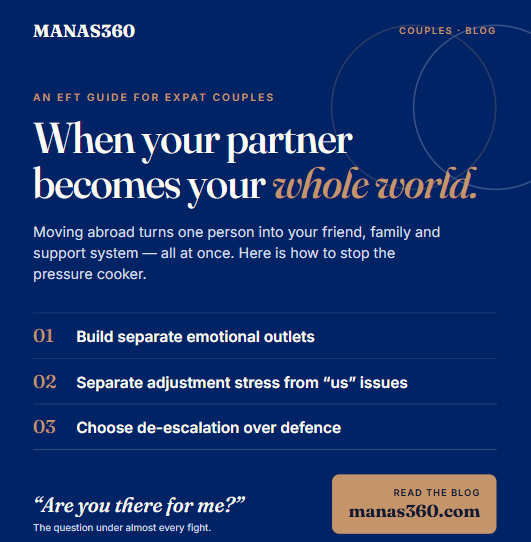
When Your Partner Becomes Your Whole World: An EFT Guide for Expat Couples
Nov 15, 2026 · @Mahan
How Emotionally Focused Therapy helps couples stay connected when an international move strips away everything familiar.
The ecosystem you didn't know you had
In your home country, your relationship exists within a broad ecosystem. You have lifelong friends, family members, familiar routines, and a cultural comfort zone. If you have an argument or feel stressed, you have multiple outlets to decompress — a call to your sister, chai with an old friend, a walk through a neighbourhood you know by heart.
When you move abroad, that ecosystem vanishes overnight.
Suddenly, your partner becomes your only friend, your sole emotional support system, your co-navigator of a foreign bureaucracy, and your only sounding board. This creates a psychological "pressure cooker." Forcing one person to fulfil every social and emotional role is unsustainable. When the stress of adjusting to a new country hits, couples often turn their collective anxiety inward — taking it out on each other through communication breakdowns or emotional withdrawal.
For many couples, this environment also magnifies existing vulnerabilities, sometimes leading to crises like infidelity as partners struggle to cope with isolation or a loss of identity.
Why EFT fits the expat experience
Emotionally Focused Therapy (EFT), developed by Dr. Sue Johnson, rests on a simple idea: adult love is an attachment bond. Just as children need to know a caregiver will show up for them, adults need to know their partner is there when it matters. Most fights are not really about the dishes, the visa paperwork, or who forgot to call the landlord. Underneath, they are about one question:
"Are you there for me?"
An international move puts this question under extraordinary pressure. When every other source of safety disappears — family, friends, language, career identity — the partner becomes the only attachment figure available. Every missed text, every distracted evening, every sharp word lands harder because there is nowhere else to turn.
EFT names three qualities that make a bond feel secure. Johnson summarizes them as A.R.E.:
Accessible — Can I reach you? Are you open to me, even when you are stressed?
Responsive — Will you respond to my emotional needs, not just the logistics?
Engaged — Do I matter to you? Will you stay close and attentive?
When expat couples feel disconnected, one or more of these has usually gone missing — not because anyone stopped caring, but because survival mode crowded it out.
The negative cycle: the real enemy
One of EFT's most freeing insights is that the problem is not your partner — it is the cycle you are both caught in.
The most common pattern is pursue–withdraw:
The pursuer feels the disconnection first. Lonely in a new city, they reach out — often as criticism, complaints, or repeated questions: "You're always on your laptop." "Do you even care that I have no one here?"
The withdrawer feels overwhelmed. Already stretched by a new job or a demanding visa process, they hear failure in every complaint. So they go quiet, retreat to work, or shut down to keep the peace.
Each move fuels the other. The more one pursues, the more the other withdraws — and the more the other withdraws, the more panicked the pursuer becomes.
Abroad, this cycle often maps onto the move itself. A common example: one partner relocated for their career (the "lead" partner) and is absorbed in a new role, while the "trailing" partner — who may have given up a job, a social circle, or a sense of purpose — is left alone with the isolation. One drowns in busyness, the other in emptiness. Both end up feeling unseen.
EFT asks couples to step back and look at the dance together: "This is the cycle that grabs us when we're scared of losing each other." Once you can name the cycle, you can fight it as a team instead of fighting each other.
Rebuilding connection: three EFT-informed shifts for expat couples
Emotionally Focused Therapy, alongside the Gottman Method, helps global couples to reconnect. Here are three core shifts you can practise today.
1. Establish separate emotional outlets
EFT is not about making your partner your everything. A secure bond is actually what makes it safe to reach outward. Couples who feel safe with each other explore the world more confidently — new friendships, new communities, new routines.
Try this:
Each partner builds at least one independent connection — a diaspora group, a language class, a sports club, a weekly video call with a close friend back home.
Frame it as care, not rejection. Say: "I want to find a few people here so I'm not putting everything on you. I want us to have more energy for each other."
Bring the outside world back in. Share what you are discovering. This keeps both partners engaged in each other's new life rather than living parallel ones.
2. Differentiate adjustment anxiety from relationship issues
Culture shock, homesickness, career loss, and bureaucratic stress produce real, raw emotions. In EFT, these are often felt first as secondary emotions — irritation, criticism, numbness — that sit on top of deeper primary emotions such as fear, sadness, and shame.
When something flares up, pause and ask:
Is this about us, or about how hard this place is right now?
What's the softer feeling under my anger? Often it is: "I feel lost here," "I feel invisible without my work," or "I'm scared I made us move for nothing."
Sharing the primary emotion changes everything. "You never help with anything!" pushes a partner away. "I feel so alone and out of my depth here, and I need to know you're with me" invites them in. This is what EFT calls a softening — and it is one of the strongest predictors of couples recovering connection.
3. Practice de-escalation over defense
The first stage of EFT is de-escalation: slowing the cycle down until both partners feel safe enough to be vulnerable. You can begin this at home.
Name the cycle out loud. "I think we're doing our thing again — I'm pushing, you're pulling away. Can we pause?"
Take a structured break when flooded. From Gottman's research, when your heart rate spikes during conflict, you lose access to calm thinking. Agree on a 20–30 minute break — and always agree on when you will return, so it does not feel like abandonment.
Respond to the need, not the attack. When your partner criticizes, try listening for the attachment longing underneath: "I hear that you're really lonely here. I don't want you to feel alone."
Hold a weekly A.R.E. check-in. Fifteen minutes, phones away. Each partner answers: When did you feel close to me this week? When did you feel far away? What would help you feel I'm there for you?
When the cycle feels too strong to break alone
Some cycles are deeply entrenched — especially after a betrayal, a long period of withdrawal, or when old wounds from childhood or past relationships are reactivated by the stress of the move. EFT calls these attachment injuries: moments when a partner was not there at a critical time, which keep resurfacing until they are repaired.
This is where working with a trained couples therapist can make a real difference. EFT has a strong research base, and a therapist can help you slow down the cycle, reach the vulnerable emotions underneath, and create new moments of reaching and responding that rebuild trust.
For couples living abroad, online therapy removes the extra barrier of finding a culturally attuned therapist in a foreign country. Sessions can happen across time zones, in a language you are comfortable with, with someone who understands the specific pressures of relocation — including family expectations from home.
Navigating the next chapter together
An international move doesn't have to break your relationship. With the right tools, it can become the crucible that makes your partnership unbreakable. The very isolation that strains you can also teach you to turn toward each other in a deeper, more honest way.
Recognizing that you need a secure space to unpack these cross-cultural and lifestyle pressures is a sign of strength, not failure.
Living abroad and feeling the distance grow between you? MANAS360 connects couples with verified therapists trained in evidence-based approaches like EFT and the Gottman Method — online, in your language, across time zones. Book a confidential session at https://manas360.com/nri-landing .
This article is for general education and is not a substitute for professional care. If you or your partner are in crisis, please contact local emergency services or a mental health helpline right away.
Tags: EFT for couples, emotionally focused therapy, expat couples therapy, #AyushForMentalHealth #Navratri2026 #mentalhealthindia #mindfulness #mentalhealth #therapyiscool Topic: #EFT #EmotionallyFocusedTherapy #CouplesTherapy #ExpatLife #NRILife #ExpatCouples #RelationshipGoals #GottmanMethod #LongDistanceFromHome #DesiAbroad #ShaadiAbroad #RishtonKiBaat #MANAS360